


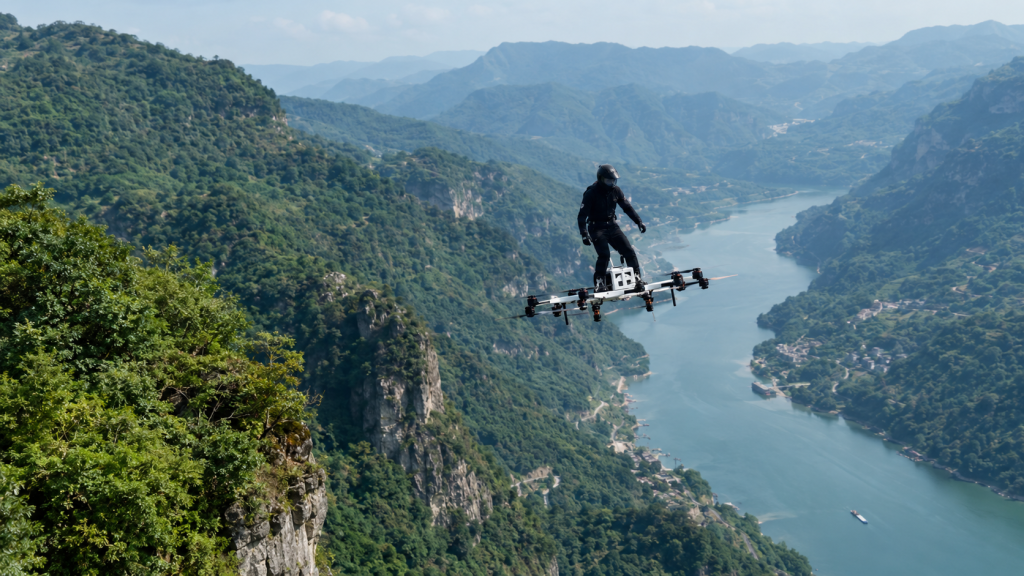
A homemade flying skateboard inspired by a science-fiction film has attracted widespread attention after its creator demonstrated the device over the Yangtze River and the mountainous landscapes of central China. Built by self-taught technology creator Song Xingyu, known online as Shenqi Ayu, the experimental machine combines electric propulsion, hands-on engineering and artificial intelligence-assisted flight monitoring.
The project has drawn attention because it brings a concept usually associated with futuristic films into the real world. However, the demonstration also highlights the engineering challenges, control difficulties and safety risks involved in developing a device capable of carrying a person through the air.
A Science-Fiction Idea Takes Flight

Song’s inspiration came from the Green Goblin’s flying glider in the Spider-Man films. Instead of treating the concept as a purely fictional idea, he set out to build a device capable of lifting a person off the ground and moving through the air.
According to reporting by Jimu News published through Chongqing’s official news portal, Song developed the latest version over approximately two months. During China’s National Day holiday in October 2026, he demonstrated the flying skateboard in his home region of Badong County, Hubei Province, including flights across the Yangtze River and through the mountainous Ba Ren River scenic area.
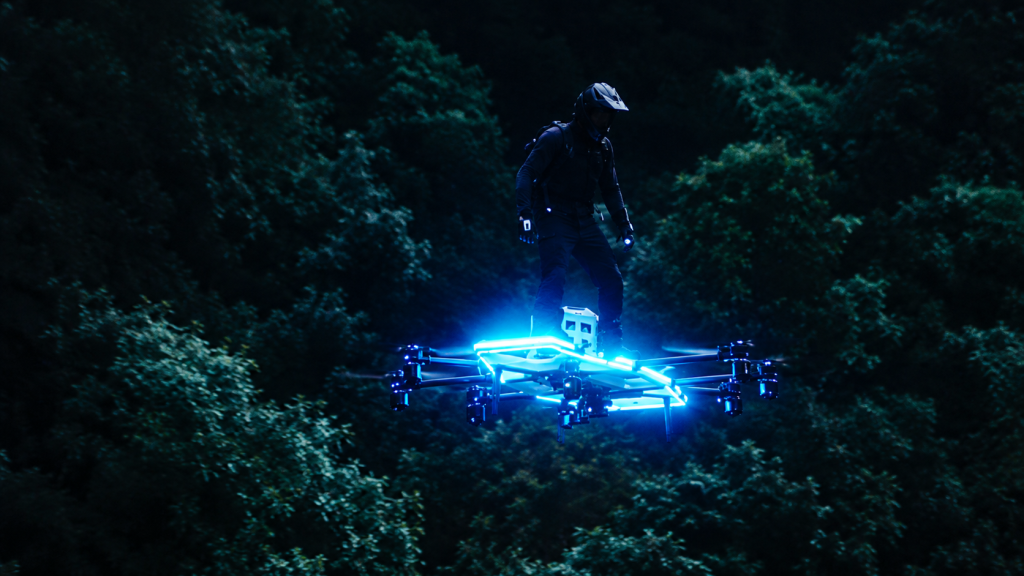
The footage shows a person standing on a compact platform while airborne, creating a visual impression more commonly associated with science-fiction films than conventional personal transportation. The demonstration spread across Chinese social media, drawing admiration for the ambition behind the project as well as questions about its safety and practical applications.
In a video report distributed by Xinhua, the experimental hoverboard is shown lifting off, hovering and making low-altitude landings. The footage provides a visual record of the prototype’s flight tests, although a short demonstration alone cannot establish its overall reliability or suitability for everyday use.
How the Flying Skateboard Works
The device emerged from repeated experimentation rather than from a ready-made consumer product. According to Jimu News reporting republished by Phoenix News, Song’s first version used five small turbojet engines. During an early test, the engines caught fire after being operated together. The report attributed the failure to their positioning, which allowed hot exhaust gases to rebound from the ground and enter the engine intakes.
Following the failure, Song abandoned the original turbojet arrangement and moved towards an electric design. The newer prototype reportedly uses ten brushless electric propulsion units. The change illustrates how testing, identifying failure points and revising a design can be central to experimental engineering.
Unlike a conventional skateboard, the device must generate enough thrust to lift its rider and maintain control while airborne. Its operator also has to manage balance, body position and power input, leaving little room for mistakes during take-off, flight or landing.
Artificial Intelligence Becomes a Flight Assistant
One of the most distinctive aspects of the project is the reported use of artificial intelligence during development. Coverage by EJ Tech, citing Hong Kong’s Hong Kong Economic Journal, describes how Song used AI assistance to examine the earlier test failure and inform the switch from turbojet engines to electric propulsion.
Song also reportedly assembled a flight-monitoring arrangement using two smartphones. During flight, AI-generated spoken feedback could be delivered through a Bluetooth earpiece, including prompts intended to help him correct his balance and body position.
The project offers an example of AI being used as a practical tool in independent hardware development. Rather than replacing the builder, the technology reportedly helped interpret test information and provide additional feedback during a demanding physical task.
However, AI assistance should not be confused with autonomous flight or a guarantee of safety. The available reporting does not establish that the device can independently avoid obstacles, respond reliably to every emergency or protect its rider against mechanical failure.
From Failed Tests to a Viral Flight

The path to a successful demonstration involved setbacks. Reports describe earlier difficulties controlling the prototype, including a test incident in which Song lost speed after mishandling the throttle and adopting an excessive upward angle. The machine was damaged, and he sustained minor injuries.
After further adjustments and training, Song completed the flights filmed during China’s October holiday period. According to Jimu News coverage published by Chutian Metropolis Daily, a demonstration in the Ba Ren River scenic area lasted a little over two minutes and covered more than 300 metres.
The same reporting described how the team prepared the location and equipment before the demonstration. It also reported that Song continued experimenting after the videos attracted widespread attention, with the creator expressing a desire to achieve greater flight heights.
Subscribe to our newsletter!
The footage generated substantial engagement on Chinese social media and attracted coverage from multiple media outlets. Viewers praised the creativity involved, while others questioned the risks of operating a homemade flying device.
An Impressive Experiment, Not Yet Everyday Transportation
The flights represent a striking experimental achievement, but they do not mean that flying skateboards are ready for mass-market use. A prototype completing a demonstration does not establish that it can operate consistently in different weather conditions, handle unexpected failures or be used safely over roads and crowded public spaces.
Personal flight systems face difficult engineering questions involving stability, battery capacity, propulsion reliability, emergency landing options, weather exposure, maintenance and rider protection. They may also be subject to aviation rules, local restrictions and other requirements that vary by jurisdiction and operating environment.
The reported fire during early testing and the subsequent flight mishap underline why safety matters. Viewers should not attempt to reproduce the device from social media footage or assume that a successful flight proves a design is safe.
For the moment, the flying skateboard is best understood as an experimental personal-flight platform. Its significance lies in demonstrating what an individual builder can attempt with engineering knowledge, repeated testing and AI-assisted analysis—not in proving that a commercially viable product is already available.
What the Project Says About the Future of Personal Flight
Interest in personal flight has grown alongside developments in electric propulsion, drone technology, flight-control systems and artificial intelligence. Researchers, companies and independent creators are exploring different ways to move people through the air, although their designs vary widely in scale, purpose and technical maturity.
Song’s project stands out because it emerged from an individual-led workshop rather than a conventional aerospace programme. It illustrates how accessible electronic components, online technical communities and AI-assisted troubleshooting can help creators explore ambitious ideas outside traditional industrial settings.
Nevertheless, moving from a working prototype to a dependable product requires much more than a viral demonstration. Repeated testing, engineering validation, appropriate operating procedures and compliance with applicable regulations would all be important steps before a device of this kind could be considered for wider use.
What Comes Next?
Song has indicated that he intends to continue experimenting and hopes to fly higher. Whether the concept develops into a more capable or practical system will depend on further engineering work, improved safety measures and evidence that the machine can perform consistently beyond individual demonstrations.
For now, the project offers a compelling glimpse into experimental engineering: a self-taught creator has turned a science-fiction-inspired concept into a machine capable of carrying a person through the air. The story also raises broader questions about the role of AI in independent invention and the challenges that remain before personal-flight devices can become practical transportation options.
Follow Simbad Ozibe Blog (S.O.Blog) for more reporting on technology, artificial intelligence, science and innovations shaping the world.
Simbad Ozibe Blog — Where Global Stories Inspire Opportunity.
Watch Now!
Stay Ahead. Stay Informed.

Get the latest stories, insights and updates from Simbad Ozibe Blog — covering News, Technology, Business, Finance, Travel, Gaming, Entertainment and more.
Join our growing community and never miss a story worth knowing.