


Song Xingyu, better known online as Shenqi Ayu, is a Chinese technology creator whose homemade flying machines have attracted widespread attention. His latest project, an electric flying skateboard inspired by the Green Goblin’s glider in Spider-Man, has brought renewed attention to a much longer pursuit: learning how to build machines that can take flight, often with limited resources and through repeated experimentation.
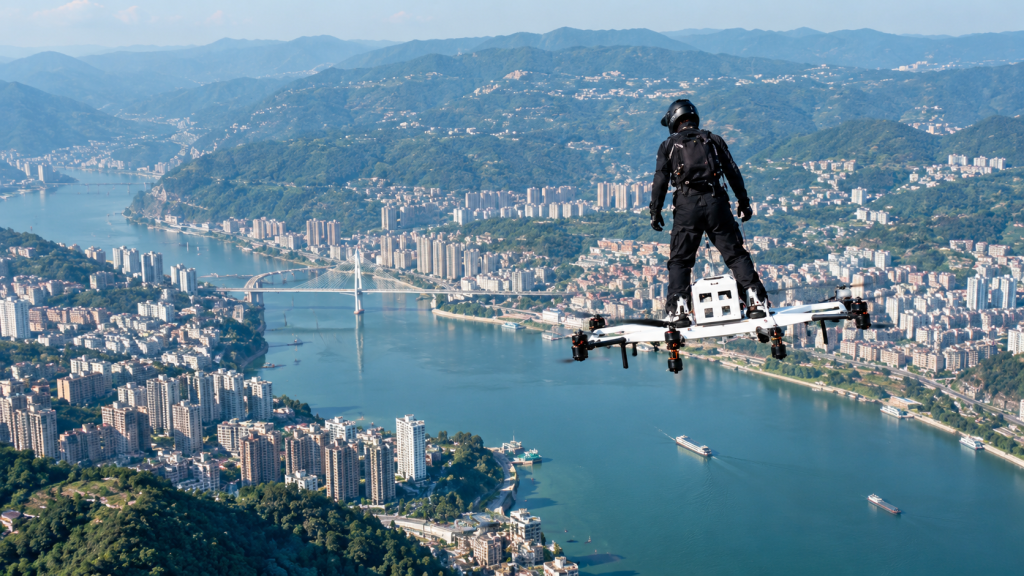
During China’s National Day holiday in October 2026, Song demonstrated the device in his home region of Badong, Hubei Province, flying over the Yangtze River and through the mountainous landscape around his hometown. Footage of the flight spread rapidly online, turning an experimental project into an international talking point. Behind the striking images, however, is a story of self-directed learning, failed prototypes, financial setbacks and the increasingly prominent role of artificial intelligence in his engineering process.
Song’s trajectory is particularly notable because his work has developed outside a conventional aerospace research programme. Rather than beginning with formal institutional backing, he has pursued his ideas through practical construction, online learning and trial and error. His experience illustrates both the possibilities of independent invention and the considerable risks involved when experimental technology is designed to carry a person into the air.
Song Xingyu at a Glance
| Full name | Song Xingyu |
|---|---|
| Online name | Shenqi Ayu, also written as Shenqi Ayu AYU |
| Country | China |
| Hometown | Badong County, Hubei Province |
| Known for | Building experimental flying machines and a homemade electric flying skateboard |
| Technical interests | Mechanical construction, flight control, electric propulsion and AI-assisted experimentation |
| Notable project | A second-generation electric flying skateboard developed after an earlier jet-powered prototype |
| Development approach | Self-directed learning, hands-on construction and repeated testing |
| Commercial status | The flying skateboard is an experimental device, not an established commercial transport product |
Biographical note: This profile draws on publicly available reporting about Song and his projects. Details about his life and work are included where they have been reported; technical performance figures and personal-history claims should be understood in that context.
Growing Up in Badong and Discovering Flight
Song comes from a rural area of Badong County in Hubei Province, part of the mountainous Enshi region of central China. In accounts of his early life, his fascination with flight began not in a university laboratory or a professional aviation workshop, but through exposure to aircraft experiments and the possibilities of building machines himself.
One published account of Song’s early years describes how a second-hand tablet given to him by a friend introduced him to videos of flight tests. The material captured his imagination and helped turn a general interest in flying into a more specific ambition: to understand the machines that made it possible and eventually build some of his own.
According to that account, Song left school at 14 and began helping at his father’s timber business. The experience placed him in a practical working environment, but it also meant that his technical development would not follow the conventional route of advanced schooling followed by university-level engineering education.
Instead, Song began learning through whatever materials and components he could obtain. When new supplies were beyond his means, he reportedly collected leftover KT foam board from advertising workshops to make model-aircraft bodies. When electronic components were difficult to source, he relied on old parts and help from people in model-aircraft communities.
His early models did not emerge fully formed. Reports describe a period of experimentation lasting a year or two before he managed to get his first aircraft model to fly. The significance of that experience lies less in any single successful flight than in the process it established: learning by building, identifying problems and returning to the design with new information.
From Practical Work to an Unconventional Engineering Path
Song’s interest in flight developed alongside the practical demands of earning a living. Accounts of his twenties describe periods of work connected with timber supply and construction, as well as unsuccessful business ventures that interrupted his attempts to concentrate on experimental projects.
For a creator working without the resources of a large engineering organisation, the challenge is not simply to devise a machine. There is also the cost of materials, the need for workspace, the availability of replacement components and the time required to test a design safely. Those constraints can determine whether an idea progresses steadily or remains an intermittent pursuit.
Song eventually developed practical experience with high-speed drones, commonly known as FPV drones. These aircraft are controlled from the operator’s perspective through a live camera feed and require an understanding of flight behaviour, electronic systems and precise control. Reporting on his background describes how drone-related work became a source of income through commercial aerial photography.
That experience is relevant to the development of his later projects. Building a drone and building a machine capable of carrying a person are not equivalent engineering tasks, but experience with flight control, electronic components and the behaviour of aircraft can provide a foundation for further experimentation. The transition to human-carrying flight, however, introduces much more demanding requirements for structural integrity, propulsion, stability and safety.
Turning a Disused Workshop into a Laboratory
One of the most distinctive details in accounts of Song’s work is the setting in which he developed his machines. Rather than operating from a purpose-built aerospace facility, he reportedly converted an unused woodworking shed belonging to his family into a workshop for his experiments.
The space offered something essential to an independent inventor: somewhere to assemble equipment, store materials and work through successive versions of a design. It was not a substitute for a fully equipped aviation laboratory, but it gave Song a base from which to continue pursuing projects that would otherwise have been difficult to develop.
Accounts of the workshop and his experimental aircraft describe a creator who has attempted a range of unconventional projects over the years, including specialised vessels, high-altitude aircraft concepts and a human-carrying flight wing. These projects differ substantially in their engineering requirements, but they share an interest in pushing beyond familiar designs.
Some of the reported experiments have involved ambitious targets and substantial technical risk. Such projects are difficult to assess fully from short videos or public descriptions alone. Their precise performance, reliability and safety cannot be established simply because a test was filmed or attracted attention online.
The Failures and Financial Setbacks Behind the Ambition
Song’s development has not been a straightforward progression from one successful invention to the next. Reports describe unsuccessful business ventures, damaged experimental equipment and financial difficulties that at times threatened to bring his work to a halt.
One account of his earlier projects describes a high-altitude aircraft experiment that failed after a separation-system problem. Other reports refer to difficulties involving a specialised vessel and losses associated with business dealings. The precise circumstances of every setback are not independently documented in the available public material, but the broader picture is of an inventor whose experiments have carried substantial financial as well as technical risks.
Some Chinese media accounts have reported that Song accumulated debts of approximately 2.4 million yuan following a combination of failed ventures and other losses. Those figures should be treated as reported details rather than an independently audited statement of his finances. The accounts also describe assistance that helped him address much of the outstanding debt.
The financial dimension helps explain why access to practical opportunities matters for independent inventors. Materials, specialised equipment and repeated testing can be expensive, and the failure of a prototype may require substantial additional investment. Even when an idea attracts public interest, that attention does not automatically provide the resources needed to develop it responsibly.
For Song, the reported setbacks form part of a wider story about persistence. They also illustrate an important distinction: determination can keep an experiment moving forward, but sound engineering depends on learning from failures rather than simply repeating risky tests.
The Flying-Wing Experiments That Came Before the Skateboard
Before the flying skateboard became his best-known project, Song had reportedly experimented with other aircraft designs, including a human-carrying flight wing powered by jet engines. One account describes a jump from a helicopter at an altitude of around 5,000 metres using a homemade wing, with a descent reportedly reaching speeds of approximately 300 kilometres per hour.
These figures are drawn from published accounts of the experiment and should not be interpreted as independently certified performance data. High-altitude jumps and powered flight-wing tests involve serious risks, including parachute failure, loss of control, structural problems and potentially fatal consequences.
Song’s reported experiments with different forms of flight nevertheless provide context for the flying skateboard. Rather than appearing as an isolated idea, the project followed years of interest in aircraft, practical construction and the challenge of controlling a machine in the air.
How the Flying Skateboard Took Shape
The inspiration for Song’s flying skateboard reportedly came from the Green Goblin’s glider in Spider-Man. The fictional machine offered a memorable visual idea: a compact platform that could carry a person above the ground without conventional wings. Song set out to explore a real-world version using electric propulsion.
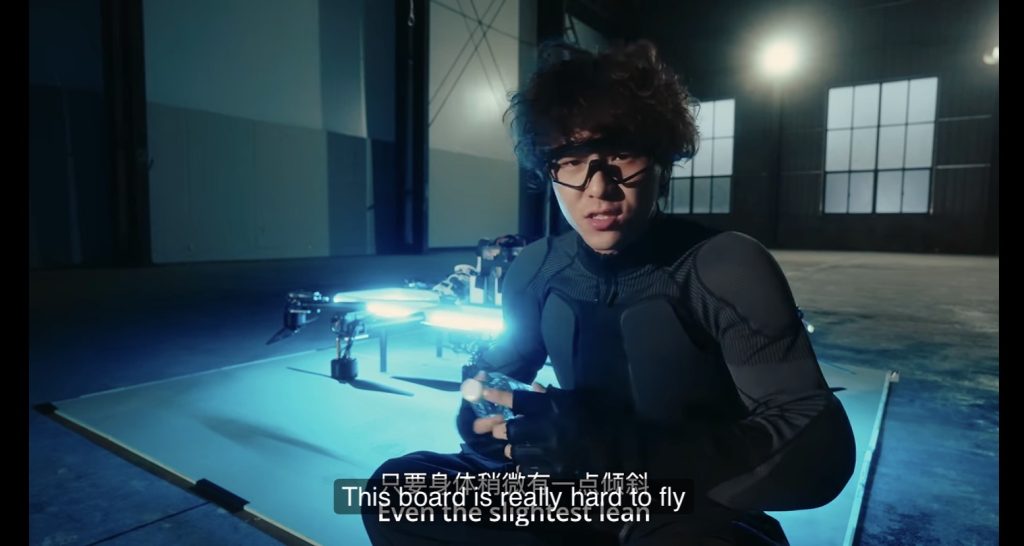
According to reports about the project, the latest version took a little over two months of development. The second-generation design uses multiple brushless electric propulsion units arranged to generate lift. Published accounts describe ten motor assemblies, although the exact configuration and performance characteristics should be distinguished from independently verified engineering specifications.
The design presents a difficult control problem. A person standing on a compact flying platform changes the distribution of weight as they move. The propulsion system must provide sufficient thrust, while the machine must respond to changes in balance and remain controllable. Unlike a conventional aircraft with established aerodynamic surfaces and control systems, a compact multirotor-style platform depends heavily on the coordination of its propulsion units and the operator’s control inputs.
Song’s first jet-powered approach reportedly ended in a fire during testing. The incident became a turning point in the project. Rather than continuing with the original propulsion concept, he examined the test data and explored a different design based on electric motors.
The change was significant because propulsion choices affect more than raw power. Heat management, the placement of engines, the flow of exhaust gases, mechanical layout and control requirements all influence whether a machine can operate as intended. A design that looks promising on paper may behave very differently during a real test.
The Role of Artificial Intelligence in His Development Process
Artificial intelligence reportedly played a role in Song’s analysis of the earlier jet-powered prototype. After the fire, he supplied test information to an AI assistant, which reportedly identified the close placement of the engines and the possible re-entry of hot exhaust gases into the air intakes as contributing factors. The analysis recommended moving away from the jet-powered arrangement and pursuing an electric design instead.
The project later incorporated a separate AI-assisted monitoring approach. Published accounts describe a system using two smartphones to help monitor the flight and deliver spoken prompts through an earpiece. The reported prompts included guidance about the rider’s balance and body position, giving Song additional information while practising control of the platform.
This is an interesting application of AI because it connects software analysis with a physical engineering challenge. AI tools can help organise test data, identify possible patterns, explain technical problems and support the review of experimental results. In a hands-on project, those capabilities may give a creator another way to investigate why a design failed and what might be changed.
That does not mean the AI system independently certified the machine or guaranteed a safe flight. The quality of its recommendations depends on the accuracy and completeness of the information it receives, and any proposed explanation still needs to be assessed against engineering evidence. In a human-carrying aircraft, incorrect advice or a failure in a critical system can have severe consequences.
The broader significance is that AI is becoming an accessible tool for people working on projects outside large research organisations. Song’s reported experience offers an example of how a creator may combine practical skills with digital assistance, while also showing why AI-supported experimentation must be accompanied by careful validation and risk management.
The Flight That Brought Him Wider Attention
After developing the electric version, Song reportedly spent more than ten days practising before the demonstration that brought his work wider attention. During the October 2026 National Day holiday, he flew the device in his home region of Badong, including a demonstration in the mountainous landscape around the Yangtze River and the Ba Ren River scenic area.
Accounts of the demonstration describe a flight lasting a little over two minutes and covering more than 300 metres. The device was shown crossing open terrain and passing through a section of the river gorge. The scenery and the compact, futuristic appearance of the machine helped make the footage particularly striking.
The flight attracted widespread online attention, with reports describing millions of likes on the creator’s video. The imagery resonated with viewers because it seemed to bring a familiar science-fiction concept into the real world. For many, the appeal was not simply that a machine had flown, but that an individual creator had assembled it through a process of experimentation.
Song’s achievement should still be understood within the limits of what the demonstration establishes. A short flight does not prove that the device can operate reliably over long distances, perform safely in varied weather, carry different riders or meet the standards required for routine transportation. Those questions would require further testing, documented performance data and independent technical assessment.
The original report on Song Xingyu’s flying skateboard and its flight over the Yangtze River region provides further context on the demonstration that introduced the project to a wider audience.
What the Project Reveals About Independent Innovation
Song’s work illustrates how online platforms can change the reach of independent invention. A project developed in a small workshop can now be seen by audiences around the world within hours, creating opportunities for technical discussion, collaboration and public interest that would once have been difficult to achieve.
That visibility can also blur the distinction between an impressive prototype and a mature technology. Videos are effective at showing a moment of success, but they rarely capture the full engineering process: the failed tests, maintenance requirements, operating limits, detailed measurements and safety procedures needed to determine whether a design is dependable.
Human-carrying flight makes those considerations especially important. High-power motors, batteries, moving components and unstable flight can create serious hazards for both the operator and bystanders. Responsible development requires more than a successful demonstration; it calls for controlled test conditions, appropriate protective measures, careful analysis and qualified technical input.
There is also a broader lesson in Song’s use of self-directed learning. His reported progress shows how curiosity, practical experience and accessible digital tools can contribute to experimentation. At the same time, his setbacks underline that learning through trial and error must be balanced with sound safety practices, particularly when an experiment carries a person off the ground.
What Could Come Next for Song Xingyu?
Song has reportedly continued experimenting and filming after the flying skateboard attracted widespread attention. In comments reported following the demonstration, he expressed an interest in continuing his tests and achieving greater flight capability. The precise direction of his future projects, however, remains uncertain.
For the flying skateboard to progress beyond an experimental demonstration, important challenges would need to be addressed. These include stability, control reliability, battery performance, structural durability, safe operating procedures and the ability to reproduce results under carefully documented conditions. Any move towards commercial use would also raise questions about applicable aviation rules, certification and liability.
Those challenges are not unique to Song. They are part of the wider difficulty of developing compact personal-flight systems. Improvements in electric propulsion and digital tools may expand what independent creators can explore, but practical transportation requires a much higher standard of reliability than a short experimental flight.
Whether Song’s design eventually develops into a more mature technology remains to be seen. For now, his work has brought renewed public attention to the people attempting to turn ambitious ideas into physical machines—and to the combination of persistence, technical learning and caution that such experiments demand.
Conclusion
Song Xingyu, known online as Shenqi Ayu, has built a public profile through his experiments with homemade flying machines, culminating in an electric flying skateboard that drew widespread attention in October 2026. His reported journey from early model-aircraft experiments to a human-carrying prototype reflects years of self-directed learning, practical construction and repeated attempts to solve difficult engineering problems.
The use of AI-assisted analysis adds another dimension to his story, showing how accessible digital tools can become part of an individual creator’s development process. Yet the project also demonstrates the limits of what a viral flight can prove. Reliability, repeatability and safety remain essential questions for any technology intended to carry people through the air.
Song’s work is therefore best understood not as proof that personal flying devices are ready for everyday use, but as a revealing example of independent experimentation in an era when digital tools and online audiences can bring ambitious projects to global attention.
Stay informed with S.O.Blog. Subscribe to the Simbad Ozibe Blog newsletter to never miss an update on global news, technology, innovation, business, entertainment and the stories shaping our world.
Stay Ahead. Stay Informed.

Get the latest stories, insights and updates from Simbad Ozibe Blog — covering News, Technology, Business, Finance, Travel, Gaming, Entertainment and more.
Join our growing community and never miss a story worth knowing.