
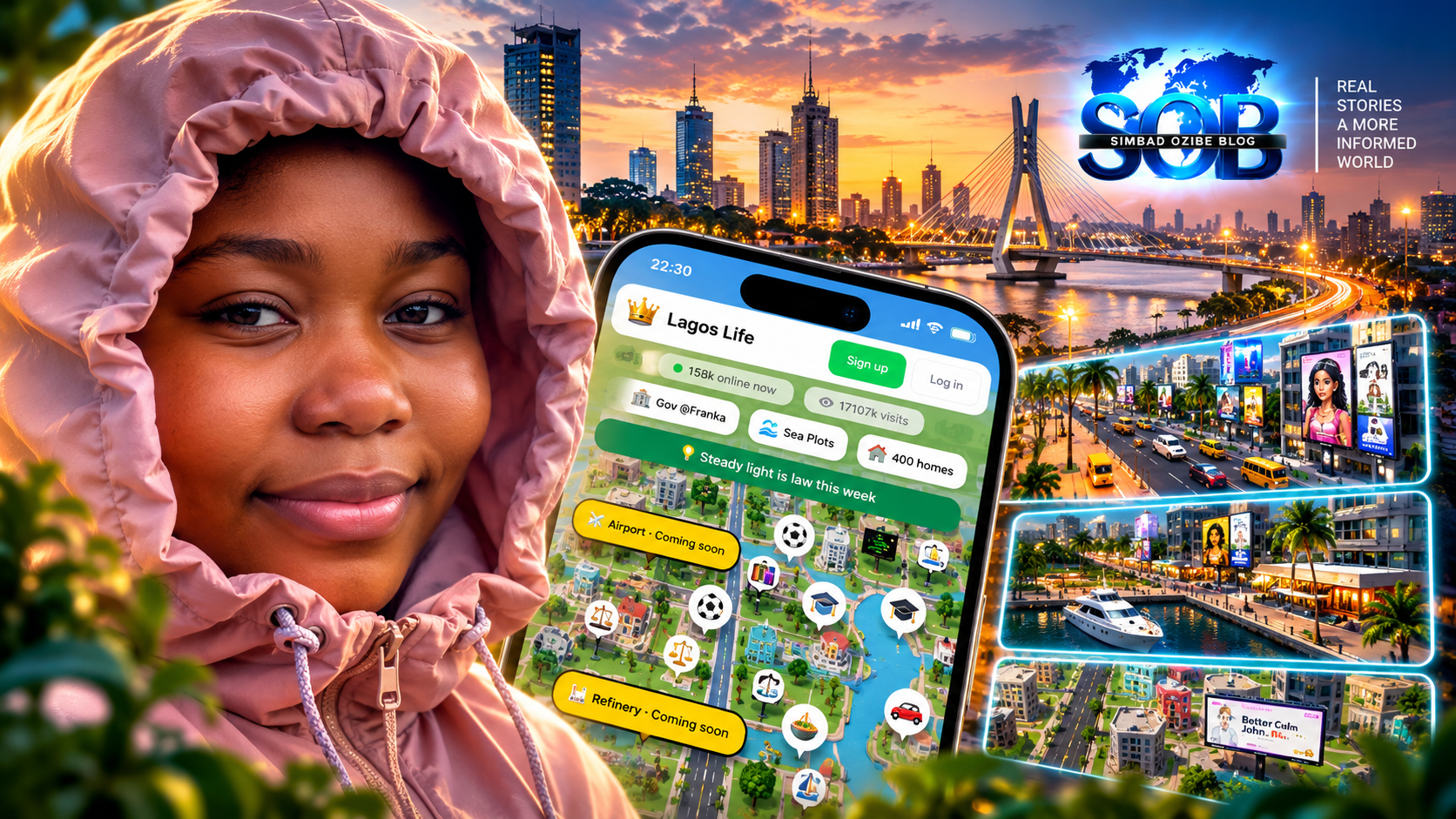
Lagos Life started with a deceptively simple idea: turn everyday Nigerian life into a playable virtual world. Within days of its October 1 launch, the browser-based game had become one of the country’s most talked-about gaming projects, with millions of players reported by its developer and the virtual map expanding beyond Lagos.
But the numbers are only the beginning of the story.
Lagos Life has brought together local culture, browser-based accessibility, multiplayer interaction and digital advertising in a single product. Its rapid rise raises bigger questions about how African developers can turn familiar places and experiences into scalable digital entertainment.
In this S.O.B. analysis, we look beyond the viral moment to examine Lagos Life’s growth, business model, cultural impact, expansion and what its rise could mean for the future of African gaming.
🎮🇳🇬 THE STORY BEHIND LAGOS LIFE — FROM THE FOUNDER HERSELF.
What Is Lagos Life?
Lagos Life is a browser-based life-simulation game created by Nigerian developer Shalom Rayhamen. Players create virtual characters, find jobs, earn and spend in-game money, rent homes, socialise, explore locations and build virtual lives inside a fictional world inspired by Nigeria.
The concept draws on the life-simulation genre popularised by The Sims, the long-running life-simulation franchise developed by Maxis and published by Electronic Arts. But Lagos Life places that familiar gameplay idea inside a distinctly Nigerian setting.
Instead of asking players to enter an unfamiliar fictional suburb, Lagos Life places them inside a world shaped by recognisable aspects of Lagos and Nigerian society.
The game’s own official disclaimer is important here: Lagos Life describes itself as a fictional entertainment experience inspired by life in Nigeria. It incorporates elements such as cities, businesses, transportation, employment, finance, property, relationships, entertainment, culture and social activity, while making clear that its scenarios and systems may be simplified, fictionalised or invented.
The game’s Terms of Service also make clear that players must be 18 or older and that in-game naira, items, houses and jobs have no real-world value and cannot be cashed out, sold or transferred outside the game.
Why Lagos Life Spread So Quickly
One of Lagos Life’s biggest advantages is also one of its simplest: there is no conventional game download.
The experience runs through a web browser, allowing people to access it from compatible phones and computers. That reduces the friction between discovering the game and actually trying it.
For a product spreading largely through social media and word of mouth, that matters. A person who sees a video or post about Lagos Life does not necessarily need a console, a large installation or a traditional app-store download. The barrier is much closer to clicking a link and entering the world.
That accessibility has become one of the most notable elements of the game’s early growth. TechNext’s coverage of Lagos Life highlighted the game’s rapid rise past one million reported players and examined how browser-based access may be changing the way Nigerian games reach audiences.
From a Virtual Lagos to a Bigger Nigerian World
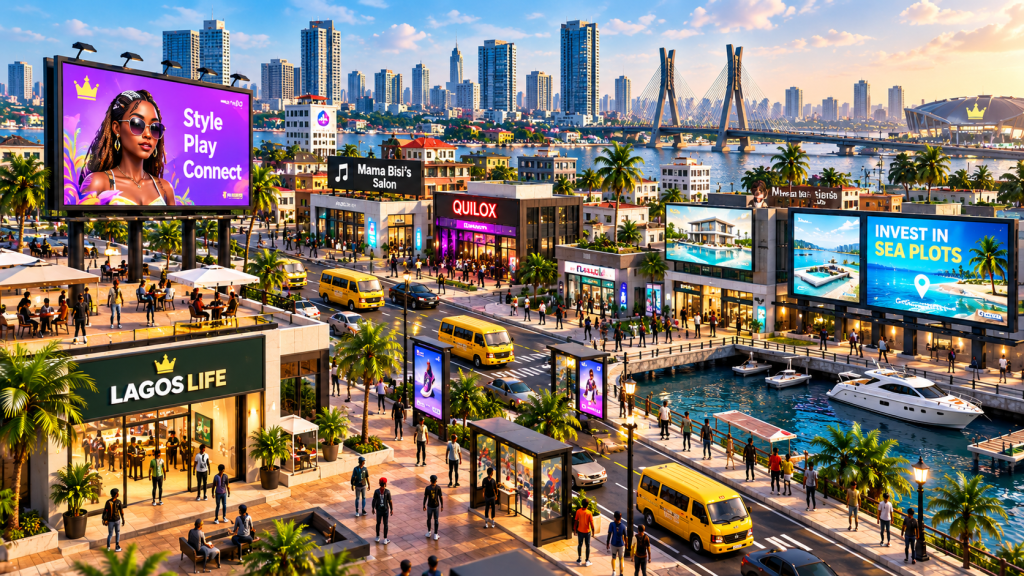
The project’s ambition has already begun expanding beyond its original Lagos setting.
Reports published on October 6 said Abuja and Port Harcourt had joined the virtual world, following the game’s explosive early growth. Western Post reported on the expansion as the game approached two million reported players less than a week after launch.
The expansion means Lagos Life is no longer simply a digital interpretation of one Nigerian city; it is beginning to resemble the foundation of a broader Nigerian virtual environment.
That direction could become important if the project eventually allows players to move between cities, encounter different environments and build a larger shared world around Nigerian locations.
For now, however, the expansion should be viewed as an emerging development rather than proof of a completed nationwide virtual world.
The Numbers Behind the Viral Moment
Lagos Life’s growth has been unusually fast.
Earlier reporting based on the game’s public dashboard recorded more than 1.2 million total players and more than 71,000 people online at the time of the reported snapshot. Vanguard’s reporting also documented the game’s rapid climb past the one-million-player mark.
Subsequent figures shared by the developer pushed the reported player count beyond 1.8 million, alongside more than 145,000 concurrent players and millions of visits.
The game’s public live statistics page provides a direct window into the platform’s reported activity, although the figures should not be confused with independently audited measurements of unique users.
Those numbers are significant, but they require context. The figures come from the game’s own dashboard and figures shared by its developer; they have not been independently audited. That means they should be treated as reported platform figures rather than independently verified measurements of unique users.
| Detail | Current information |
|---|---|
| Developer | Shalom Rayhamen |
| Country | Nigeria |
| Launch | October 1, 2026 |
| Format | Browser-based life simulation |
| Primary setting | Lagos |
| Expansion reported | Abuja and Port Harcourt |
| Age requirement | 18+ |
| Reported scale | More than 1.8 million players, according to recent reports |
| Data caveat | Player figures are not independently audited |
Lagos Life Is Turning Its Virtual World Into a Business
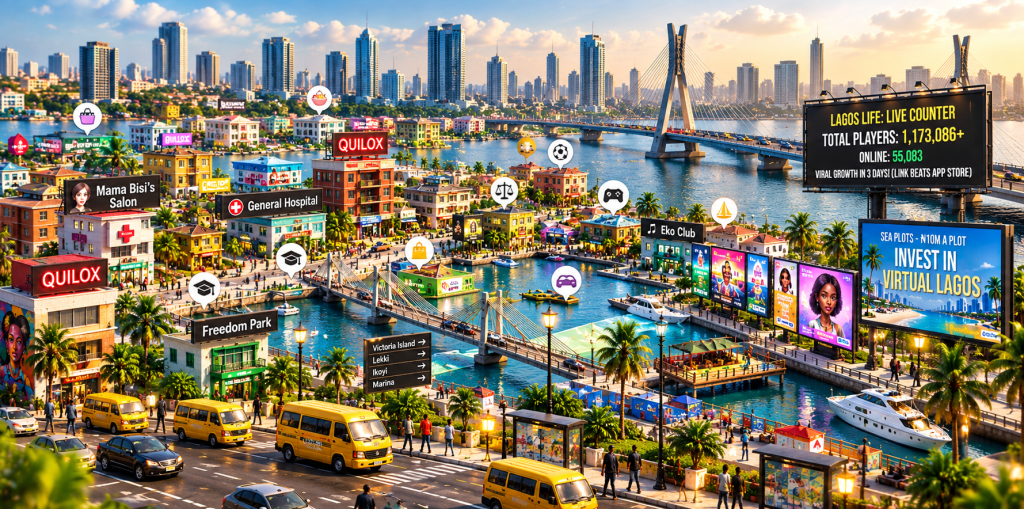
The game’s commercial strategy may be just as interesting as its player growth.
Lagos Life operates an official advertising platform that allows businesses to purchase virtual advertising space inside the game. Brands can place advertising on digital billboards around the virtual city, while additional placements are available on the game’s live statistics page.
That creates a different relationship between gaming and advertising. The game does not simply exist as a product that people consume; its virtual environment becomes part of the advertising inventory.
A business can place its brand inside the same digital environment where players are working virtual jobs, visiting locations and interacting with other users.
The advertising rates published by Lagos Life can change as the platform develops. Readers interested in current placements can consult the game’s official advertising page for the latest commercial offering.
The game’s Terms of Service also establish rules governing advertising and brand placements, giving the virtual environment a commercial layer that goes beyond traditional game sales or in-game purchases.
Why the Cultural Context Matters
The most important part of Lagos Life may be the decision to make Nigerian life itself part of the game’s appeal.
Players are not simply being given a Nigerian character inside a generic international game world. The environment, economic pressures, transportation, social interactions, locations and cultural references are central to the experience.
Arise News’ reporting on Lagos Life illustrates how the game’s familiar economic labels, social locations, entertainment spaces and everyday activities have helped turn aspects of Lagos life into gameplay.
That points to a broader opportunity for African game developers.
Local culture can be more than background decoration. It can become gameplay, storytelling, identity and intellectual property.
That opportunity sits within a wider African gaming market that is attracting increasing attention. The 2025 Africa Games Industry Report from KPMG describes a rapidly evolving African gaming sector shaped by mobile gaming, a young population, digital infrastructure and emerging opportunities for developers, investors and policymakers.
A developer who understands the humour, language, environments, social dynamics and everyday experiences of a particular market possesses something global studios cannot simply reproduce through a marketing campaign.
The challenge is turning that cultural familiarity into a product that remains compelling even after the initial novelty disappears.
The Harder Part Starts After Going Viral
Rapid growth creates its own problems.
A game that suddenly attracts tens of thousands of simultaneous players has to manage infrastructure, moderation, security, technical reliability and the stability of its virtual economy at a scale that may be very different from what the original product was designed for.
Reports have already highlighted a brief outage and an exploit involving the game’s virtual economy during its early growth. Arise News reported on the virtual-economy exploit and the developer’s subsequent response, including the resetting of exploited funds.
The game’s Terms of Service also make clear that players are not permitted to cheat, exploit bugs or interfere with the game or its servers.
Those incidents are not necessarily unusual for a rapidly growing online product. But they illustrate the central challenge facing Lagos Life now: going viral is one achievement; building a durable game is another.
Can a Nigerian Game Become Global Gaming IP?
This is where Lagos Life becomes bigger than a viral gaming story.
African developers have often faced the challenge of building products that can compete for attention in a global entertainment market dominated by companies with enormous budgets and established franchises.
Lagos Life offers a different proposition: start with a world that already feels authentic to the people who created it.
The opportunity is not necessarily to build an African imitation of an established Western franchise. It is to transform African places, experiences, humour, social dynamics and stories into original entertainment properties that can eventually travel beyond their place of origin.
The broader African games ecosystem is already producing evidence of this potential. The Africa Games Industry Report tracks studios, developers, players, investment and the wider growth of interactive entertainment across the continent.
If Lagos Life can retain its audience, expand its world, strengthen its technology and build a sustainable commercial model, its importance could extend well beyond its initial viral moment.
What Happens Next?
The next stage will tell us more than the launch numbers.
Can Lagos Life keep players returning after the novelty fades? Can its advertising model become sustainable? Can its virtual economy remain stable? Can additional Nigerian cities become part of a genuinely connected world? And can the project transform its early cultural momentum into a long-term gaming franchise?
Those questions cannot be answered yet.
What can be said is that Lagos Life has already demonstrated something worth paying attention to: there is an audience for interactive entertainment that reflects African experiences in a way that feels recognisably local.
The game’s reported rise is therefore more than another viral internet moment. It is an early test of whether African cultural experiences can become scalable digital entertainment — and whether a virtual Lagos can become the beginning of something much bigger.
For African gaming, that may ultimately be the more important story.
Stay Connected With S.O.B.
Want important stories delivered directly to your inbox? Join the S.O.B. Newsletter and become part of our growing global community, receiving selected stories, major developments and useful updates from our newsroom.
Join the newsletter, join the conversation, and stay connected with the world.
Frequently Asked Questions About Lagos Life
What is Lagos Life?
Lagos Life is a Nigerian browser-based life-simulation game created by Shalom Rayhamen. The game turns everyday Nigerian experiences, places, businesses and social activities into an interactive virtual world inspired by life in Lagos.
Who created Lagos Life?
Lagos Life was created by Nigerian developer Shalom Rayhamen, who is credited by the game’s official website and statistics page. The project was designed around a fictionalized digital version of Nigerian life.
When did Lagos Life launch?
Lagos Life launched on October 1, 2026, Nigeria’s Independence Day. Its browser-based format allowed people to access the game without requiring a conventional console or app-store download.
How do you play Lagos Life?
Lagos Life can be accessed through a web browser. Players enter the virtual world, create or use their in-game identity and interact with different locations, activities, businesses, properties and other elements of the simulated Lagos environment.
Why did Lagos Life become so popular?
Lagos Life combines familiar Nigerian culture with an accessible browser-based gaming experience. Its recognizable locations, local references, social features, virtual businesses and rapid expansion helped turn the game into a major online conversation shortly after launch.
How does Lagos Life make money?
Lagos Life is developing a commercial model around its virtual world, including digital advertising and other in-game commercial opportunities. Businesses can potentially reach players through virtual billboards and placements, while the platform also features virtual property concepts such as sea plots.
What are virtual billboards in Lagos Life?
Virtual billboards are advertising spaces placed inside the Lagos Life environment. They allow brands and businesses to appear within the game world, turning locations that would normally function only as part of the game environment into potential advertising inventory.
Does Lagos Life have virtual real estate?
Yes. Lagos Life features virtual property concepts, including sea plots, as part of its developing digital economy. These assets exist within the game environment and should not be confused with physical Nigerian real estate.
Is money or property in Lagos Life real?
No. According to Lagos Life’s official terms, in-game naira, items and virtual assets have no real-world monetary value and cannot be cashed out or transferred outside the game. Players should therefore distinguish the game’s virtual economy from real-world financial assets.
Is Lagos Life available outside Lagos?
Lagos is the central setting of the game, but the platform has also begun expanding its virtual world beyond Lagos. Abuja and Port Harcourt have been reported as part of its expansion, showing how the project could develop into a broader Nigerian virtual world.
What could Lagos Life mean for African gaming?
Lagos Life demonstrates how African developers can build digital entertainment around local culture, places and everyday experiences rather than relying entirely on imported settings. If its audience, commercial model and technical infrastructure continue to grow, the project could become an important case study in the development of locally rooted African gaming and digital entertainment.
Stay Ahead. Stay Informed.

Get the latest stories, insights and updates from Simbad Ozibe Blog — covering News, Technology, Business, Finance, Travel, Gaming, Entertainment and more.
Join our growing community and never miss a story worth knowing.
The business-model angle is the sharpest part of this piece. A browser game with no install friction can pull millions of players in days, but the durable question is the weekly loop: Lagos Life makes players take jobs, earn virtual naira and then face rent on a schedule, which quietly turns casual visits into budgeting practice. I follow the player side of that economy and keep a free salary-and-rent planner for the game (lagosmoney.fun) – the first LAPO-start rent cycle is where most players decide whether to stay. If the virtual map keeps expanding beyond Lagos while the economy keeps this weekly rhythm, that combination is exactly what could make African-made games sticky beyond the initial viral wave.