

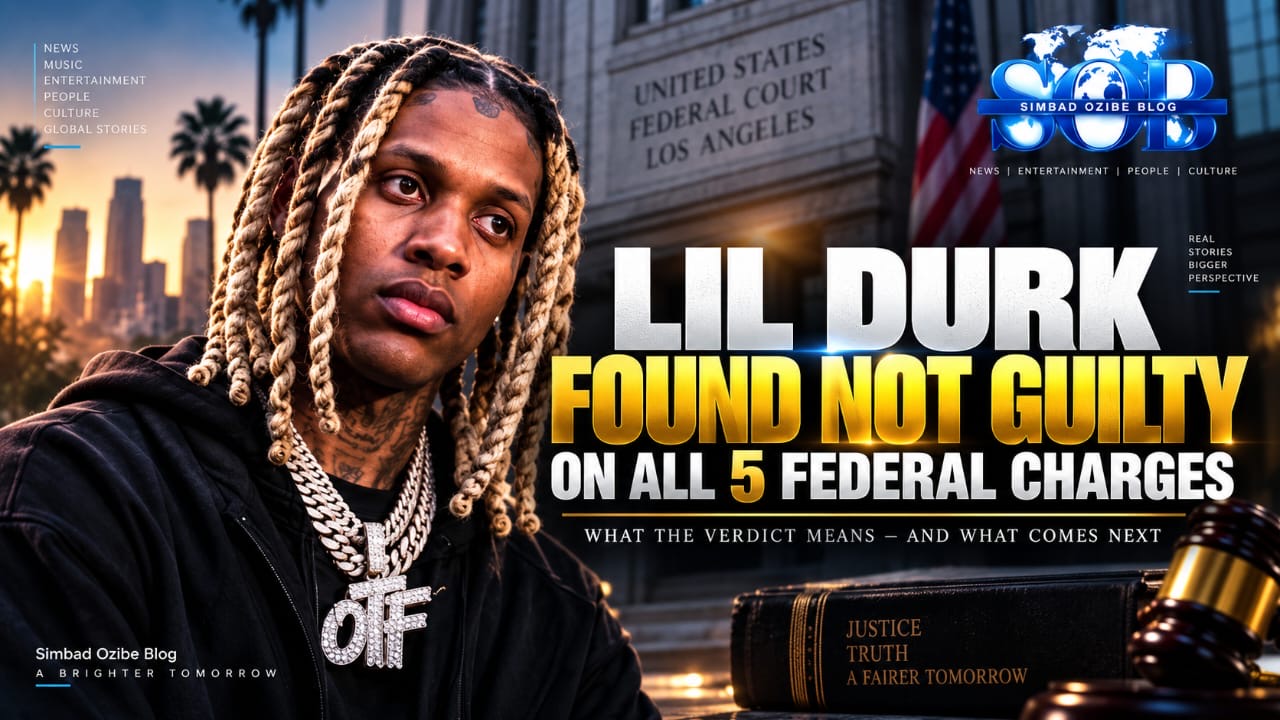
Lil Durk has been found not guilty on all five federal charges in the high-profile murder-for-hire case that placed the Grammy-winning rapper at the center of a deadly 2022 shooting in Los Angeles.
A federal jury in Los Angeles returned the verdict on Friday, September 11, 2026, after three days of deliberations, bringing the murder-for-hire trial to an end after weeks of testimony and arguments.
But there is an important detail that should not be lost in the headline: Lil Durk has not been released from custody. Although he was cleared of every charge presented in this trial, he remains in federal custody while awaiting a separate federal case scheduled to begin on October 5, 2026.
The distinction matters because the verdict represents a major legal victory for Durk in one case, but it does not end his broader federal legal battle.
Here is what happened, what the jury decided, why the prosecution’s case failed to secure a conviction and what comes next for the Chicago rapper.
Lil Durk Is Found Not Guilty on All Five Charges
The federal jury found Durk Banks, professionally known as Lil Durk, not guilty on all five charges brought against him in connection with the alleged murder-for-hire plot.
The five charges were:
| Charge | What It Related To |
|---|---|
| Conspiracy to commit interstate stalking | An alleged plan to track and target Quando Rondo |
| Interstate stalking involving a dangerous weapon | The alleged pursuit of Rondo using a dangerous weapon |
| Interstate stalking resulting in death | The allegation that the stalking campaign ultimately resulted in Saviay’a Robinson’s death |
| Conspiracy to use interstate facilities to commit murder-for-hire resulting in death | The alleged interstate organization of the murder-for-hire scheme |
| Use of interstate facilities to commit murder-for-hire resulting in death | The allegation that interstate facilities were used in carrying out the alleged plot |
The verdict means the government did not obtain convictions against Durk on any of those five counts.
That is different from saying that a jury formally declared every allegation surrounding the wider dispute untrue. In a criminal trial, an acquittal means the prosecution failed to prove the charged offenses beyond a reasonable doubt to the jury’s satisfaction.
What Was the Lil Durk Murder-for-Hire Case About?
The case centered on a shooting that happened in Los Angeles on August 19, 2022.
Prosecutors alleged that Durk was behind an effort to kill Atlanta rapper Quando Rondo, whose legal name is Tyquian Bowman.
According to the prosecution’s theory, the alleged plot was motivated by the 2020 killing of Durk’s close friend and fellow rapper King Von, whose legal name was Dayvon Bennett.
Prosecutors argued that Durk wanted revenge and used members and associates of his Only the Family, or OTF, collective to pursue Rondo.
But the alleged attack did not unfold as prosecutors said it was intended to.
Rondo survived the shooting, while his cousin, Saviay’a Robinson, was fatally shot.
That death became the central tragedy around which the federal case was built.
The U.S. Department of Justice’s original federal charging announcement described an alleged conspiracy involving a rival rapper and the shooting death of the rival’s relative near the Beverly Center in Los Angeles.
How the King Von Connection Became Central to the Case
The roots of the prosecution’s theory went back to Atlanta in 2020.
King Von was killed in Atlanta following a confrontation involving people associated with Quando Rondo. Prosecutors later argued that the killing helped create the motive for the alleged retaliation against Rondo.
That connection became one of the most important pieces of the government’s narrative.
Prosecutors portrayed Durk as an artist who had become increasingly determined to avenge his friend’s death and argued that his influence, money and connections allowed him to put other people in motion.
The defense offered a very different interpretation.
Rather than portraying Durk as the architect of the Los Angeles attack, his attorneys argued that his former personal assistant, Kavon Grant, had independently helped organize the operation.
The defense also argued that key government witnesses had strong incentives to shift blame toward Durk because they had entered plea agreements or faced serious criminal exposure of their own.
What Prosecutors Said Happened
The prosecution’s case depended heavily on testimony from people connected to the alleged operation.
Among the witnesses were Kacey Hester, also known as OTF Jam, Keith Jones and Kavon Grant.
According to trial reporting by The New York Times, prosecutors argued that Durk used his resources and influence to push associates toward revenge against Bowman.
Hester testified that he was among the people who followed Bowman’s vehicle around Los Angeles before the fatal shooting at a gas station.
Grant also testified about alleged efforts to locate Bowman and about earlier attempts to retaliate against him.
Another witness, Jones, testified that Durk had offered a large financial reward for Bowman’s killing, according to trial reporting.
Prosecutors therefore attempted to connect several pieces of evidence: the alleged motive arising from King Von’s death, communications and interactions involving Durk’s associates, the movements of people involved in the shooting, and testimony from cooperating witnesses.
The government also introduced material from Durk’s music and public statements as part of its attempt to establish his state of mind and alleged motivation.
The Defense’s Strategy: Attack the Witnesses and the Government’s Theory
Durk’s defense focused heavily on the credibility of the government’s cooperating witnesses.
His attorneys argued that several witnesses had pleaded guilty or faced significant prison exposure and therefore had reasons to give prosecutors testimony that could improve their own situations.
The defense also placed significant attention on Kavon Grant.
Attorneys argued that Grant had access to resources associated with Durk and could have organized elements of the attack without Durk directing him to do so.
That argument became particularly important because the prosecution did not allege that Durk personally carried out the shooting.
The government’s theory was that he could still be held responsible for helping organize, finance or direct the alleged operation.
The defense instead attempted to create reasonable doubt about whether Durk actually ordered the attack and whether the government’s witnesses could be trusted.
In closing arguments, defense attorneys repeatedly attacked the cooperating witnesses as people attempting to reduce their own punishment by implicating Durk.
The Jury’s Decision Changed the Case
After the prosecution and defense presented their cases, the jury began deliberating.
The deliberations lasted three days.
When the verdicts were finally read on September 11, Durk was cleared on every count.
According to Reuters, Durk was acquitted of all charges in the federal murder-for-hire case.
The verdict represented a dramatic reversal from the government’s position throughout the trial, which had argued that Durk’s influence and resources were central to the alleged operation.
For Durk’s defense, however, the outcome confirmed the importance of challenging the reliability of the prosecution’s witnesses and the government’s ability to connect Durk directly to the alleged scheme.
Why Was Lil Durk Acquitted?
The jury did not publicly provide a detailed explanation for its verdict.
That means it would be inappropriate to claim that one specific piece of evidence caused the acquittal.
What can be established from the trial is that the defense successfully placed significant questions around the prosecution’s evidence, particularly the testimony of cooperating witnesses.
The government’s case depended heavily on people who were themselves involved in the events under investigation and who had entered plea agreements or faced serious criminal consequences.
The defense used that fact to argue that their accounts could not be trusted without stronger independent evidence connecting Durk to the alleged plot.
The jury ultimately concluded that the prosecution had not established Durk’s guilt beyond a reasonable doubt on the five charges.
That is the legal significance of the acquittal.
What Happened to Lil Durk’s Co-Defendants?
Durk was not the only defendant whose fate was decided in the trial.
Deandre Dontrell Wilson and David Brian Lindsey were also tried alongside him.
Their verdicts were different.
Both men were acquitted of the murder-for-hire-related charges but were convicted on stalking-related counts, including conspiracy to commit stalking, stalking involving a dangerous weapon and stalking resulting in death.
The mixed verdicts highlight how the jury treated the evidence against each defendant separately rather than simply reaching one collective conclusion about the entire prosecution theory.
Reuters and the Associated Press both reported the different outcomes for Durk and his co-defendants.
Lil Durk Is Not Free Yet: Why He Remains in Custody
This is perhaps the most important part of the story for anyone seeing headlines about the acquittal.
Lil Durk remains in federal custody.
That does not mean the jury’s verdict was reversed or that he was convicted in the murder-for-hire case.
Instead, Durk is facing a separate federal case.
Reuters reports that he remains in custody while awaiting a separate trial involving murder-related racketeering and weapons offenses.
That trial is scheduled to begin on October 5, 2026.
In other words, the September 11 verdict resolved one federal case against Durk. It did not resolve every federal charge he faces.
This distinction is why claims suggesting that Durk has been completely cleared of all legal problems or is automatically walking out of custody would be misleading.
Important: Lil Durk was found not guilty on all five charges in the murder-for-hire trial. He remains in custody because a separate federal case is still pending, with a trial scheduled for October 5, 2026.
What Is the Separate Federal Case?
The remaining federal case is broader than the murder-for-hire prosecution that just ended.
Prosecutors have accused Durk of involvement in a broader criminal enterprise and have brought murder-related racketeering and weapons allegations that are separate from the five charges decided by the jury on September 11.
The government has described the allegations in the remaining case as connected to activity involving the Only the Family organization.
Because those allegations have not yet been decided at trial, they remain allegations, not established facts.
Durk remains entitled to the presumption of innocence on the charges that are still pending.
The October 5 proceeding will therefore be another major legal test for the rapper and could determine whether the September acquittal becomes the beginning of a path toward freedom or simply one victory in a much larger legal battle.
How Long Has Lil Durk Been in Federal Custody?
Durk was arrested in October 2024 after federal prosecutors charged him in connection with the alleged murder-for-hire plot.
The Department of Justice’s 2024 announcement identified Durk Banks, also known as Lil Durk, as a defendant in the federal case.
He has remained in federal custody during the lengthy proceedings.
That makes the September 11 acquittal particularly significant: after nearly two years of federal detention connected to the broader legal saga, Durk has now secured an acquittal in the murder-for-hire prosecution, but his custody continues because another case remains unresolved.
Who Is Lil Durk?
Born Durk Banks, Lil Durk is a Chicago rapper who became one of the most commercially successful artists to emerge from the city’s drill music scene.
His career expanded from Chicago’s local rap movement into mainstream American hip-hop, collaborations with major artists and international recognition.
One of his biggest career milestones came in 2024, when The Recording Academy listed “All My Life” by Lil Durk featuring J. Cole as the winner of the Grammy Award for Best Melodic Rap Performance.
That success made the legal case even more prominent in entertainment coverage because it placed one of contemporary hip-hop’s most recognizable artists at the center of a major federal prosecution.
Why the Verdict Matters Beyond Lil Durk
The case has become larger than a single celebrity trial.
It sits at the intersection of music, criminal justice, social media, organized-crime allegations and the difficult question of how prosecutors can use an artist’s creative work in a criminal case.
The prosecution’s use of music-related material also attracted attention because rap lyrics and artistic expression can carry very different meanings depending on context.
That issue has become increasingly important in American criminal trials involving hip-hop artists, where prosecutors have sometimes attempted to use lyrics, videos or public statements as evidence of intent, motive or state of mind.
The Durk case therefore became another major test of how a court and jury interpret the boundary between an artist’s public persona and evidence of alleged criminal conduct.
What Happens Next for Lil Durk?
The immediate next step is not a music release, concert or return to the stage.
It is another courtroom.
Lil Durk’s separate federal trial is scheduled to begin on October 5, 2026, according to Reuters and other current reports.
Until that case is resolved, his legal situation remains unsettled.
The September acquittal could nevertheless become an important part of the next phase of his defense. His lawyers now have a significant courtroom victory to point to after successfully defeating every charge in the first federal trial.
But it would be premature to predict the outcome of the second case.
For now, the most accurate description is simple: Lil Durk won the murder-for-hire case, but his wider federal legal battle is not over.
What the Lil Durk Verdict Means Right Now
The September 11 verdict gives Lil Durk one of the biggest legal victories of his career.
He was accused of helping organize a revenge attack against Quando Rondo, an attack that prosecutors said ultimately resulted in the death of Rondo’s cousin, Saviay’a Robinson.
After a closely watched federal trial, the jury did not convict Durk on any of the five charges.
That outcome means the government failed to prove those charges beyond a reasonable doubt.
But the story does not end with the words “not guilty.”
Durk remains in custody, and another federal trial is scheduled for October.
For fans, the music industry and anyone following the case, the next few weeks could therefore become another important chapter in one of the most closely watched legal stories involving a major hip-hop artist.
What Do You Think?
What do you make of the Lil Durk verdict?
Do you think the jury made the right decision based on the evidence presented during the trial? And what do you expect from the separate federal case scheduled for October 5?
Share your thoughts in the comments and join the conversation.
For more breaking entertainment, music and celebrity news, explore the S.O.B. Entertainment section and stay connected with Simbad Ozibe Blog (S.O.B.).
Don’t forget to follow S.O.B. across social media and subscribe to the S.O.B. Newsletter for major stories, updates and original reporting delivered directly to you.
Frequently Asked Questions
Was Lil Durk found guilty or not guilty?
Lil Durk was found not guilty on all five federal charges in the murder-for-hire trial in Los Angeles on September 11, 2026.
What were the five charges against Lil Durk?
The five charges involved conspiracy to commit interstate stalking, interstate stalking involving a dangerous weapon, interstate stalking resulting in death, conspiracy to use interstate facilities to commit murder-for-hire resulting in death, and using interstate facilities to commit murder-for-hire resulting in death.
Why is Lil Durk still in custody if he was found not guilty?
He remains in custody because he faces a separate federal case involving murder-related racketeering and weapons offenses. That case is scheduled for trial on October 5, 2026.
What was the Lil Durk murder-for-hire case about?
Prosecutors alleged that Durk organized a revenge plot targeting rapper Quando Rondo following the 2020 killing of Durk’s friend King Von. The 2022 Los Angeles attack resulted in the death of Rondo’s cousin, Saviay’a Robinson.
Did Lil Durk personally carry out the shooting?
Prosecutors did not allege that Durk personally fired the shots. Their theory was that he helped organize, finance or direct the alleged operation through associates. The defense disputed that theory and argued that others were responsible for organizing the attack.
When is Lil Durk’s next federal trial?
The separate federal trial is currently scheduled to begin on October 5, 2026.
Does the acquittal mean Lil Durk has been cleared of every legal allegation?
No. The acquittal cleared him of the five charges decided in this particular murder-for-hire trial. A separate federal case remains pending, and Durk continues to face those unresolved allegations.
Final Thoughts
Lil Durk’s September 11 acquittal is a major development in a legal saga that has followed the rapper since his 2024 arrest.
The jury rejected the government’s case against him on all five charges tied to the alleged murder-for-hire plot, giving Durk a decisive courtroom victory.
But the most important detail for readers to remember is that the legal story is not finished.
Durk remains in federal custody ahead of another trial scheduled for October 5. Until that case reaches a conclusion, his future remains uncertain.
For now, one chapter has ended — and another is already waiting.
Keep following Simbad Ozibe Blog (S.O.B.) for verified updates as this story develops.
Stay Ahead. Stay Informed.

Get the latest stories, insights and updates from Simbad Ozibe Blog — covering News, Technology, Business, Finance, Travel, Gaming, Entertainment and more.
Join our growing community and never miss a story worth knowing.