

South Korea Lowers Tariffs in Landmark US Trade Deal
SEOUL, South Korea — In a move set to redefine economic relations between the United States and South Korea, both countries have agreed on a landmark trade deal to lower tariffs and expand mutual investments, government officials confirmed on Wednesday.
According to Kim Yong-beom, a senior South Korean presidential aide, the two nations reached an agreement to reduce reciprocal tariffs from 25% to 15%. This breakthrough follows months of high-level negotiations and aligns with South Korea’s broader economic reform policies. For detailed insights on the trade process, visit our Business section.
Under the deal, South Korea will invest $350 billion in the United States — including $200 billion in cash and $150 billion in shipbuilding and industrial development. The plan aims to create thousands of jobs and deepen cooperation across sectors such as defense, renewable energy, and semiconductor technology. Official confirmation and policy details are available via Korea.net.
“A Tremendous Meeting,” Says President Trump
U.S. President Donald Trump, who is currently on a week-long tour of Asia, described the agreement as “pretty much finalized” following a two-hour dinner meeting with South Korean President Lee Jae Myung in Gyeongju. A readout of their discussions was released by the White House.
“We had a tremendous meeting today with South Korea,” Trump stated. “A lot was determined, and we came to conclusions on several very important items — from economic cooperation to national security.” For more coverage, visit our News section or read analysis by Reuters and the Financial Times.
Prior to this meeting, both governments had expressed caution about reaching a major breakthrough, disappointing South Korean industries such as electronics, chip manufacturing, and automotive — all of which had been heavily affected by previous tariffs. You can find related reports in our Technology section.
Strategic Investments and Economic Impact
As part of the agreement, South Korea committed to purchasing $100 billion worth of liquefied natural gas (LNG) from the United States, expanding their strategic energy alliance. Analysts predict that this deal will stabilize supply chains and boost U.S. exports. More background is available at Bloomberg and APEC.
While relations between the two nations remain strong, negotiations were occasionally strained. The White House initially pushed for higher U.S.-based investments from South Korean companies, leading to debates within Seoul’s National Assembly. Coverage of the domestic response can be found in The Korea Herald.
Diplomatic Balancing in a Divided Region
The renewed trade pact comes amid regional challenges — including a recent U.S. immigration enforcement operation that detained hundreds of South Koreans. Both sides reaffirmed their commitment to diplomacy and cooperation. Related developments are covered in The New York Times and Simbad Ozibe Blog News.
President Trump will next meet Chinese President Xi Jinping on the sidelines of the Asia-Pacific Economic Cooperation (APEC) Summit in Gyeongju — their first meeting since Trump took office in 2025. Discussions are expected to cover trade balance, digital innovation, and North Korea’s ongoing missile tests.
“We’ve been talking a lot over the past month,” Trump said. “I think we’re going to have something that’s very satisfactory for both China and the United States.” Addressing CEOs at APEC, he reiterated that “economic security is national security.”
Historic Honors and Symbolic Gestures
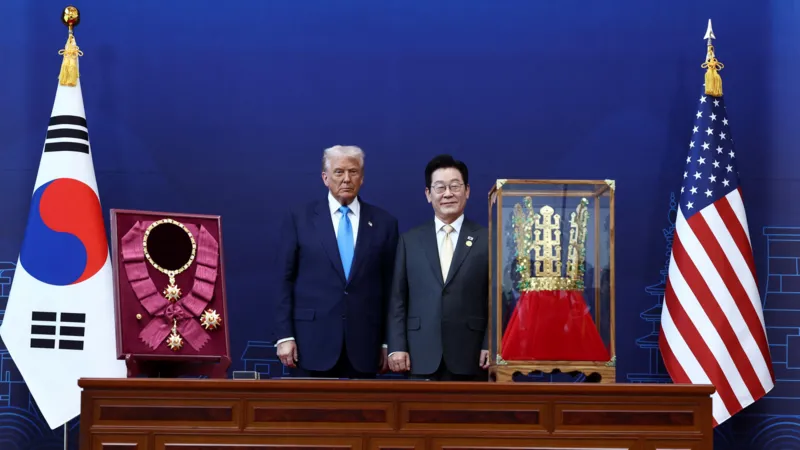
Earlier in the day, President Trump received South Korea’s highest national honor — the Grand Order of Mugunghwa — during an elaborate welcoming ceremony at the Blue House in Seoul. The award, presented by President Lee Jae Myung, recognizes his “contribution to peace and stability on the Korean Peninsula.”
“I’d like to wear it right now,” Trump joked during the ceremony, drawing laughter from the audience. The two leaders later held a private lunch to finalize the trade announcement and discuss upcoming defense cooperation agreements.
Public Reaction and Global Context
Outside the summit venue, demonstrations reflected both opposition and support for the U.S. leader. While small anti-Trump groups were dispersed by police, larger gatherings of pro-U.S. supporters also took place nearby. For independent coverage, see The Korea Times and Reuters Asia.
Political analysts note that anti-Chinese sentiment in South Korea has grown in recent years, as public opinion increasingly favors closer alignment with Western economies. Read commentary on this shift in our Business insights section.
Broader Asian Tour and Regional Cooperation
Before arriving in Seoul, Trump signed a rare earth minerals agreement with Japan to strengthen supply chains and reduce dependency on China. Later, he attended the ASEAN summit in Malaysia, where he oversaw the signing of a peace accord between Thailand and Cambodia following months of border tension.
These moves, analysts say, indicate Washington’s renewed commitment to rebuilding economic partnerships across Asia. For similar geopolitical updates, visit our News section.
A New Chapter in U.S.–Korea Relations
Experts view this new trade pact as a turning point for U.S.–South Korea relations. By reducing tariffs, expanding industrial cooperation, and promoting technology exchange, both nations are set to benefit from stronger economic resilience and regional stability. More commentary is available at CSIS and CFR.
“This is more than just trade,” said a Seoul-based economist. “It’s about long-term partnership and redefining global collaboration for the 21st century.”
Further Reading
- Reuters — Latest trade updates
- AP News — Asia-Pacific coverage
- Financial Times — Expert economic analysis
- Korea.net — Government releases
- WhiteHouse.gov — Official statements
— Reported by Simbad Ozibe Blog International Desk | Visit more stories on News, Business, and Technology.
Your point of view caught my eye and was very interesting. Thanks. I have a question for you.