

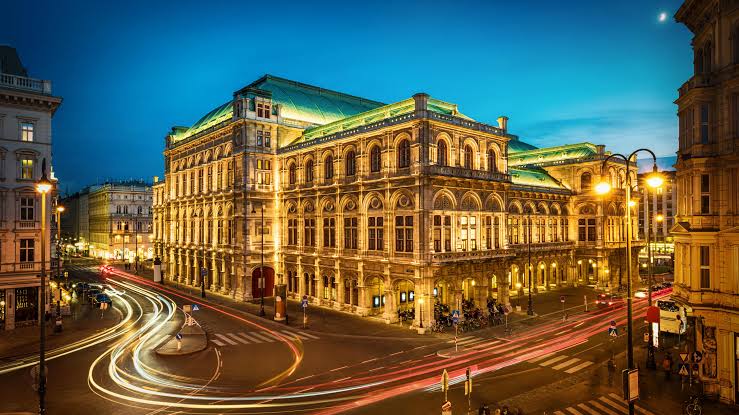
The Vienna State Opera, also known as the Wiener Staatsoper, is one of the world’s most renowned opera houses and one of the most important cultural landmarks in Vienna, Austria.
Located along Vienna’s famous Ringstrasse, the opera house has played a major role in the city’s musical and cultural history for more than 150 years. It is particularly associated with the rich tradition of Austrian classical music and has hosted performances by some of the most celebrated composers, conductors, singers and musicians in history.
A Brief History of the Vienna State Opera

The present Vienna State Opera building was constructed between 1861 and 1869 as one of the major architectural projects of Vienna’s Ringstrasse. The design was created by the Viennese architects August Sicard von Sicardsburg and Eduard van der Nüll, with the building designed in the Neo-Renaissance style.
The construction of the opera house was part of the major transformation of Vienna during the 19th century. The new Ringstrasse was being developed with monumental public buildings intended to reflect the importance of the imperial capital.
The Opening in 1869

The opera house officially opened on May 25, 1869, with a performance of Wolfgang Amadeus Mozart’s Don Giovanni. The performance was given in German and was attended by Emperor Franz Joseph and Empress Elisabeth.
According to the Vienna State Opera’s official performance archive, the opening performance began at 7 p.m. on May 25, 1869, marking the formal opening of the new opera house on the Ring.
A Controversial Beginning
Although the building would eventually become one of Vienna’s most famous landmarks, its early reception was not entirely positive. The architects faced criticism during the construction of the opera house, and changes to the level of the Ringstrasse made the building appear lower in relation to its surroundings.
This led critics to mockingly refer to the building as a “sunken box.” The criticism was particularly difficult for Eduard van der Nüll, who died by suicide before the official opening. August Sicard von Sicardsburg died shortly afterwards, meaning that neither of the two principal architects lived to see the completed opera house open its doors.
Despite its difficult beginning, the building eventually became an important symbol of Vienna’s musical identity and developed an international reputation.
A Major Centre of Classical Music
Over the decades, the Vienna State Opera became closely associated with some of the greatest names in classical music. One of the most significant periods in its history came under the direction of Gustav Mahler, who introduced important changes to the way performances were prepared and presented.
The institution’s history has also been connected with other major conductors and musical figures, helping establish Vienna as one of the world’s leading centres for opera.
The Vienna State Opera During World War II
The opera house also experienced one of the darkest periods in its history during the Second World War. Under Nazi rule, Jewish and politically persecuted artists and employees were removed, persecuted or forced to leave their positions.
In March 1945, the building suffered severe damage during bombing and fire. Large parts of the opera house, including the stage, were destroyed, while some important areas such as the main staircase, foyer and loggia survived.
The building was subsequently reconstructed, and the Vienna State Opera eventually reopened on November 5, 1955, with Beethoven’s Fidelio. The reopening became an important symbol of Austria’s post-war recovery. [oai_citation:2‡vienna.info](https://www.wien.info/en/art-culture/ringstrasse/most-important-public-buildings-352268?utm_source=chatgpt.com)
The Architecture and Interior
The Vienna State Opera is known for its elaborate Neo-Renaissance architecture and richly decorated interior. Several historic areas of the building have survived and remain important examples of 19th-century Viennese architecture.
The official Vienna State Opera describes the main vestibule, central staircase, Schwind foyer, loggia and tea room as parts of the historic interior that have been preserved. The building also contains artistic works and decorations associated with several important artists of the period.
Its architecture is therefore an attraction in its own right, even for visitors who do not attend an opera performance.
Take a Deep Look Inside the Vienna State Opera
Visiting the Vienna State Opera
Today, the Vienna State Opera remains one of Vienna’s most important cultural attractions. Visitors can attend opera and ballet performances, explore the building through guided experiences and learn more about its long artistic history.
The opera house also has an extensive programme, with performances taking place throughout the year. Visitors should check the official Vienna State Opera website for current performances, tours, ticket information and visitor arrangements.
For Bookings and Enquiries
For tours, activities and travel experiences in Vienna, you can also explore available options through Viator’s Vienna activities and tours.
Why the Vienna State Opera Is Worth Visiting
- It is one of the world’s most famous opera houses.
- The current building dates back to 1869.
- It has a strong connection to Vienna’s classical music tradition.
- Its Neo-Renaissance architecture and historic interiors are major attractions.
- It has hosted generations of internationally recognised musicians and performers.
- Its history reflects important periods in Vienna and Austria’s cultural development.
Final Thoughts
The Vienna State Opera is much more than a beautiful building. It is a living part of Vienna’s cultural history and one of the institutions that helped establish the city as a global centre for classical music.
From its opening with Mozart’s Don Giovanni in 1869 to its destruction during World War II and eventual reopening in 1955, the opera house has experienced triumph, controversy, destruction and renewal.
Today, it continues to welcome performers and audiences from around the world, preserving Vienna’s long-standing connection with opera and classical music.
Have You Visited the Vienna State Opera?
Also Read!
Maragogi Beach
If you are interested in discovering another fascinating destination, check out our article on Maragogi Beach and explore another remarkable destination.
What do you think about this historic opera house? Would you like to visit the Vienna State Opera and experience a live performance in person? Let us know your thoughts in the comment section.
Stay Ahead. Stay Informed.

Get the latest stories, insights and updates from Simbad Ozibe Blog — covering News, Technology, Business, Finance, Travel, Gaming, Entertainment and more.
Join our growing community and never miss a story worth knowing.